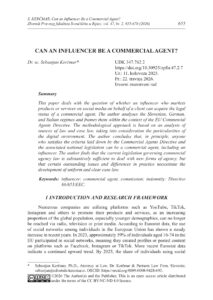
Attorney-at-law and certified specialist Dr. Sebastjan Kerčmar of DR. KERČMAR & PARTNERS LAW FIRM Ltd. has published a scientific paper entitled CAN AN INFLUENCER BE A COMMERCIAL AGENT? in the Collected Papers of the Law Faculty of the University of Rijeka.
The journal is indexed in renowned international bibliographic databases, including Web of Science – ESCI, Scopus, HeinOnline and ProQuest, giving the publication an important international scientific dimension.
The scientific paper addresses the highly topical legal question of whether an influencer who markets or promotes a client’s products or services through social media may acquire the legal status of a commercial agent.
The rapid development of the digital economy, social media and new business models raises numerous new legal questions and requires an assessment of whether, and in what manner, traditional legal concepts may also be applied to contemporary forms of digital business and marketing.
In the paper, Dr. Sebastjan Kerčmar provides a comparative legal analysis of the legal frameworks of Slovenia, Germany and Italy, placing them within the framework of Council Directive 86/653/EEC on the coordination of the laws of the Member States relating to self-employed commercial agents. Particular attention is devoted to the specific characteristics of the digital environment and to legal issues arising in judicial and legal practice in connection with new forms of marketing and intermediation.
One of the central conclusions of the research is that, in principle, any person who fulfils the requirements laid down by Directive 86/653/EEC and the relevant national legislation may qualify as a commercial agent – including an influencer.
The analysis further demonstrates that the existing legal framework governing commercial agency is, in substance, sufficiently flexible to encompass new and evolving forms of agency. Nevertheless, certain unresolved issues and divergences in legal practice point to the need for the further development of consistent, predictable and clear case law.
With the continued development of the digital economy, the legal classification of new forms of digital intermediation and marketing is expected to become increasingly significant. New business models are placing traditional legal concepts before new challenges while, at the same time, creating opportunities for their continued development and adaptation to contemporary economic realities.
The full scientific paper is available at the following link:
https://ojs.srce.hr/zpfsr/article/view/37896/20292